
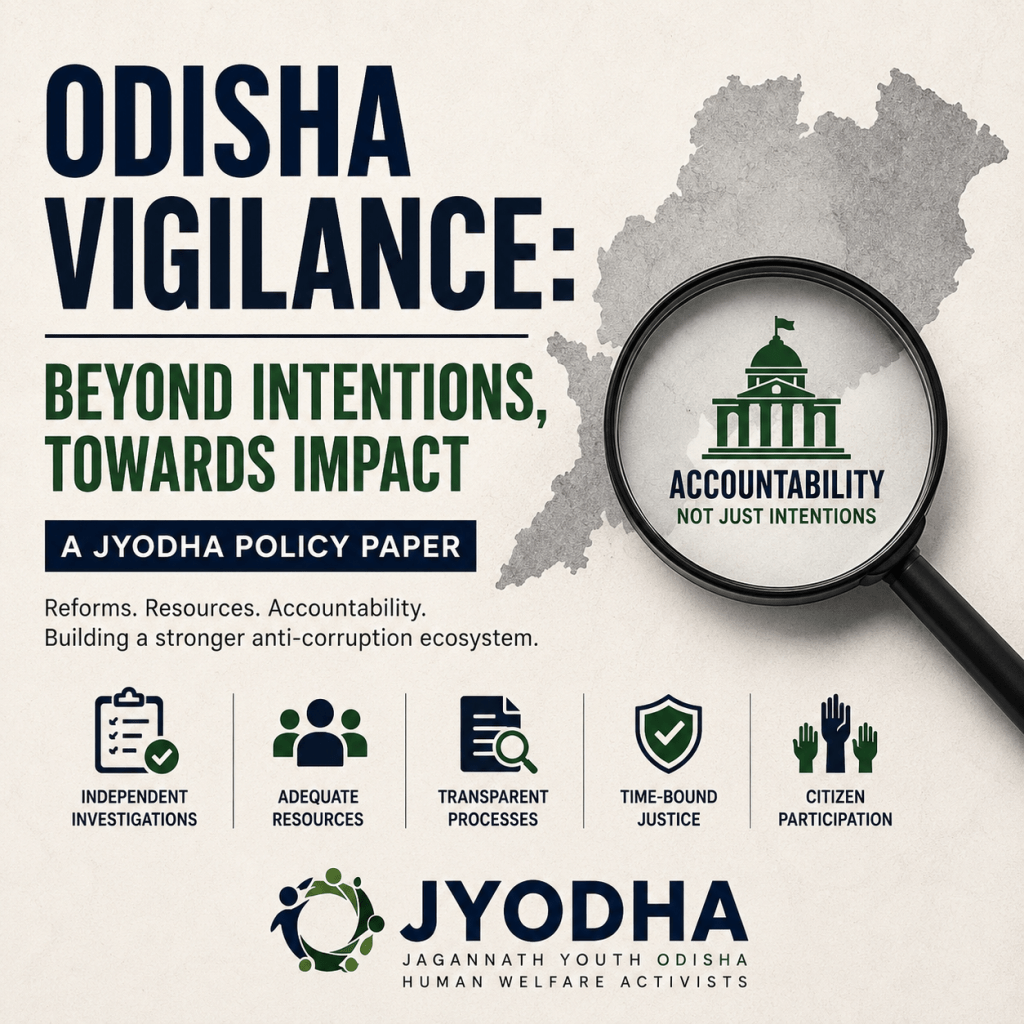
JYODHA POLICY PAPERS
Governance & Institutional Reforms Series
Policy Paper No. 001
A Policy Review of Odisha’s Anti-Corruption Ecosystem
Editorial Note
This policy review is based on an examination of the official website of Odisha Vigilance, the Prevention of Corruption Act, the Odisha Special Courts Act, the Odisha Special Courts Rules, Vigilance Instructional Handbooks, departmental circulars and judicial precedents.
Its purpose is to encourage informed public discussion on strengthening Odisha’s anti-corruption ecosystem.
Corruption: More Than Just Bribe Money
Corruption is often understood as the exchange of illegal money between a public servant and a citizen. In reality, its consequences are far wider.
Every rupee diverted from public funds reduces the quality of roads, hospitals, schools, irrigation systems, drinking water projects and welfare programmes. Corruption delays development, discourages honest businesses, increases project costs and weakens public confidence in government institutions.
For Odisha, a State which is aspiring to attract investment, improve infrastructure and accelerate economic growth, an effective anti-corruption framework is not merely a legal necessity. It is an economic necessity.
Odisha Vigilance: An Institution Older Than Many Realise
Many citizens associate Odisha Vigilance only with raids shown on television. Few ever realise that it is among the oldest specialised anti-corruption organisations in the country.
The organisation traces its origins to the Anti-Corruption Branch established in 1944 during the pre-Independence period. Over the decades, it evolved into the present-day Odisha Vigilance Organisation, expanding from investigating bribery complaints to handling complex financial investigations, disproportionate assets cases, technical examinations of public works and preventive vigilance.
Today, the organisation functions under the administrative control of the Government of Odisha and operates through specialised units located across the State. It comprises police officers, engineers, financial investigators, prosecutors and technical experts working together to investigate corruption involving public servants.
Mission of Odisha Vigilance
“To prevent, detect and prosecute corruption in public administration while promoting integrity, transparency and public confidence in governance.”
Unlike ordinary police investigations, vigilance investigations frequently involve financial analysis, engineering assessments, valuation of immovable property, scrutiny of bank transactions and examination of public procurement records.
The Legal Foundation of Odisha Vigilance
One of the strongest features of Odisha Vigilance is that it is not governed by a single statute. Instead, it operates within a comprehensive legal and procedural framework built over several decades.
The principal legal pillars are:
1. Prevention of Corruption Act, 1988
The Prevention of Corruption Act forms the backbone of anti-corruption law in India. It defines who qualifies as a public servant, specifies corruption-related offences, provides powers of investigation and prosecution, and prescribes penalties for offences such as accepting illegal gratification, criminal misconduct and possession of disproportionate assets.
The Act also establishes safeguards relating to prosecution, evidentiary requirements and the jurisdiction of Special Judges. It has undergone significant amendments to address evolving forms of corruption while balancing the need to protect honest public servants from frivolous prosecution.
The effectiveness of any anti-corruption law ultimately depends not merely on the powers it grants, but on the speed, fairness and consistency with which those powers are exercised.
2. Odisha Special Courts Act, 2006
Recognising that corruption cases often remain pending for years, Odisha enacted the Special Courts Act to facilitate the speedy trial of corruption cases involving persons holding high public or political office.
An important feature of the Act is its provision enabling confiscation proceedings relating to assets alleged to have been acquired through corrupt means, subject to judicial determination. The underlying principle is that anti-corruption efforts should not merely punish offenders but also deprive them of the benefits derived from corruption.
3. Odisha Special Courts Rules, 2007
The Rules operationalise the Special Courts Act by prescribing procedural requirements relating to confiscation proceedings, appointment of authorised officers, filing procedures and judicial administration.
While often overlooked, procedural rules are critical because they determine how statutory powers are exercised in practice.
4. Odisha Vigilance Instructional Handbook
Perhaps the least-known but most important document governing Odisha Vigilance is its Instructional Handbook. Unlike Acts enacted by the Legislature, the Handbook serves as an operational manual for vigilance officers.
- Collection of intelligence
- Secret verification
- Open enquiries
- Registration of criminal cases
- Trap operations
- Disproportionate assets investigations
- Searches and seizures
- Prosecution
- Departmental proceedings
- Preventive vigilance
- Quarterly crime reviews
- Supervisory responsibilities
The Handbook is supplemented by numerous departmental circulars issued over several decades, reflecting institutional learning from experience and judicial decisions. Together, these documents create a detailed framework that seeks to ensure consistency, legality and procedural fairness in vigilance investigations.
What Exactly Can Odisha Vigilance Investigate?
The jurisdiction of Odisha Vigilance is often misunderstood.
Its primary responsibility is not to investigate every criminal offence but specifically offences involving corruption by public servants.
These include:
- Demand or acceptance of illegal gratification.
- Possession of assets disproportionate to known sources of income.
- Criminal misconduct.
- Abuse of official position.
- Certain offences involving criminal breach of trust, cheating, forgery and related misconduct committed by public servants where jurisdiction has been notified.
The organisation investigates employees of the State Government, public sector undertakings, local bodies, cooperative institutions and other public authorities falling within its jurisdiction.
At the same time, Odisha Vigilance is not a substitute for the regular police, nor does it adjudicate civil disputes, contractual disagreements or purely private criminal matters.
How a Vigilance Case Begins?
Contrary to popular perception, a vigilance case does not ordinarily begin with an immediate raid.
The internal procedures followed by Odisha Vigilance generally involve multiple stages.
Information may originate from a citizen complaint, intelligence gathering or source information.
Depending on the nature of the allegation, the organisation may conduct secret verification before deciding whether sufficient material exists to justify an open enquiry or registration of a criminal case.
Only after legal requirements are satisfied does the matter progress to formal investigation.
A vigilance raid is often the most visible stage of an investigation, but it is rarely the first. Behind every successful case lies weeks or months of verification, evidence collection and legal scrutiny.
For trap cases, careful planning, independent witnesses and scientific handling of evidence are essential because the prosecution must ultimately establish the legal ingredients of the offence before a court of law.
Similarly, disproportionate assets cases require meticulous financial analysis involving income, expenditure, movable assets, immovable properties, liabilities and valuation over a defined “check period.”
These investigations often take months, sometimes years, because every calculation may later be scrutinised by defence lawyers and the judiciary.
Beyond Headlines
The legal and institutional framework discussed above demonstrates that Odisha Vigilance is considerably more sophisticated than the public image created by occasional raid photographs.
The organisation functions within an elaborate network of statutes, procedural rules, departmental manuals and judicial precedents designed to balance effective investigation with procedural fairness.
However, this understanding leads to a more important question.
If Odisha already possesses such an extensive legal framework, why does corruption continue to surface with alarming regularity?
Is the challenge one of inadequate laws?
Weak implementation?
Delayed justice?
Insufficient transparency?
Or does the answer lie somewhere deeper within Odisha’s governance ecosystem?
These are the questions that the next part of this series will examine through official performance data, institutional metrics and an evidence-based assessment of Odisha Vigilance’s effectiveness.
Part II – Performance, Transparency and Institutional Accountability
The previous part explained how Odisha Vigilance functions and the extensive legal framework that governs its investigations. The organisation is supported by the Prevention of Corruption Act, the Odisha Special Courts Act, the Special Courts Rules, internal operational manuals and decades of judicial precedents.
The obvious question that follows is:
Has this institutional framework translated into measurable success?
To answer that, we must move beyond newspaper headlines and examine the Department’s own performance indicators.
What Do the Official Numbers Say?
According to the official Performance Report published by Odisha Vigilance for 2025, the Department reported:
| Performance Indicator | 2025 |
| Criminal cases registered | 205 |
| Trap cases | 98 |
| Disproportionate Assets cases | 49 |
| Other criminal misconduct cases | 58 |
| Persons arrested | 220 |
| Simultaneous search locations | 489 |
| Bank accounts frozen | 1,199 |
| Investigations completed | 488 |
| Persons charge-sheeted | 893 |
| Convictions secured | 108 |
| Conviction rate | Approximately 50% |
| Public servants dismissed | 23 |
| Pensionary benefits stopped | 50 |
On paper, these figures indicate an active anti-corruption organisation. Few State agencies investigate such a large number of public servants every year.
These efforts deserve recognition.
However, public policy requires us to ask a different question.
Do these statistics alone measure institutional success?
Measuring Activity vs Measuring Impact
There is an important distinction between activity indicators and impact indicators.
Most of the statistics released by Odisha Vigilance measure activity.
For example:
- Number of raids
- Number of searches
- Number of arrests
- Number of cases registered
- Number of charge sheets
These indicate that the Department is functioning.
But citizens are ultimately interested in outcomes.
Questions such as:
- Has corruption reduced?
- Has public money been recovered?
- Are investigations becoming faster?
- Are convictions increasing?
- Are repeat offenders reducing?
These are impact indicators.
Odisha’s Public Conversation Ends Too Early
Every Vigilance raid receives enormous publicity.
Television channels broadcast photographs of seized cash.
Social media circulates videos of counting machines, jewellery and documents recovered during searches.
Political leaders issue statements.
Within forty-eight hours, public attention moves to the next story.
But the public rarely follows what happens afterwards.
For example:
- Was the investigation completed within one year?
- Was the charge sheet filed without delay?
- Did departmental proceedings begin immediately?
- Was the accused ultimately convicted or acquitted?
- If convicted, how much illegal wealth was confiscated?
- Was the financial loss to the Government recovered?
These questions rarely become part of public discourse.
Yet they are the true indicators of an anti-corruption system.
Transparency: What Odisha Vigilance Already Does Well
The Department deserves credit for several transparency initiatives.
Unlike many public institutions, Odisha Vigilance maintains an informative official website that provides:
- Organisational structure
- Powers and jurisdiction
- Frequently Asked Questions (FAQs)
- Complaint mechanisms
- RTI disclosures
- Annual performance reports
- Recent vigilance cases
- Contact details
- Downloadable legal publications
Its official social media presence also keeps citizens informed about important enforcement actions.
These initiatives improve public awareness and encourage citizens to report corruption.
From the perspective of institutional openness, these are significant strengths.
But Transparency Must Go Beyond Raids
Transparency is not merely about informing citizens that a raid has taken place.
It is equally about informing them whether the anti-corruption system is delivering justice.
Several important performance indicators are either not routinely published or not easily accessible in consolidated form.
For example:
Investigation Performance
- Average time taken to complete investigations.
- Number of investigations pending beyond one year.
- Reasons for investigation delays.
Judicial Performance
- Average duration of Special Court trials.
- Appeal disposal rates.
- Conviction trends over multiple years.
- Reasons for acquittals.
Departmental Accountability
- Average time taken to initiate departmental proceedings.
- Average time taken to conclude disciplinary action.
- Number of officials compulsorily retired.
- Number of pensions withheld.
- Recovery of financial losses caused to Government.
Institutional Learning
- Which departments generate the highest number of vigilance cases?
- Which departments have shown improvement?
- Which departments repeatedly produce disproportionate assets cases?
Publishing such information annually would help citizens understand not merely where corruption is detected, but where governance reforms are most urgently required.
Transparency is complete only when citizens can follow the entire journey of a corruption case—from complaint to conviction, recovery and institutional reform.
Measuring the Right Things
Suppose two States report the following.
State A
- 500 Vigilance cases.
- 500 arrests.
State B
- 150 Vigilance cases.
- 90% conviction rate.
- Investigations completed within one year.
- Departmental action completed within six months.
- Corruption complaints declining annually.
Which State has the stronger anti-corruption system?
The answer is not immediately obvious.
A larger number of cases may indicate either:
- Better enforcement
- More widespread corruption
Similarly, fewer cases may indicate either:
- Lower corruption
- Weaker enforcement
Therefore, numbers require context.
This is why international anti-corruption agencies increasingly evaluate institutions using multiple performance indicators rather than relying solely on arrest statistics.
Preventive Vigilance: The Missing Conversation
One aspect that deserves greater attention is preventive vigilance.
The Odisha Vigilance Instructional Handbook itself recognises preventive vigilance as one of the Department’s important functions.
Unfortunately, public discourse rarely discusses it.
Imagine a Government department where five engineers are caught accepting bribes within three years.
The obvious question should be:
Why does this department repeatedly produce corruption cases?
Instead of waiting for the sixth officer to be caught, preventive vigilance should identify:
- Procedural weaknesses
- Excessive discretion
- Lack of digital monitoring
- Weak internal controls
- Procurement loopholes
- Absence of supervisory accountability
Preventing corruption is significantly cheaper than investigating it after public money has already been lost.
The greatest success of an anti-corruption institution is not catching more offenders—it is creating a system in which fewer people are able to offend.
Where Does Politics Enter?
This is where the discussion becomes uncomfortable.
Whenever Odisha Vigilance conducts successful raids, the ruling Government understandably highlights them as evidence of its commitment against corruption.
There is merit in acknowledging successful investigations.
However, governance cannot be evaluated only by enforcement.
Citizens are equally entitled to ask:
- How many convictions followed?
- How much public money was recovered?
- How many departmental proceedings were completed?
- What systemic reforms were introduced after major corruption cases?
Unfortunately, these questions rarely receive the same political attention.
The Opposition, too, often limits its criticism to allegations of selective action or individual cases.
Far less attention is devoted to institutional reforms.
Questions regarding conviction rates, departmental accountability, transparency standards, investigation timelines or preventive vigilance seldom become subjects of sustained legislative debate.
As a result, Odisha’s political discourse frequently revolves around individual corruption cases rather than strengthening the institutions responsible for combating corruption.
JYODHA’s Preliminary Assessment
Based on the legal framework, publicly available performance reports and institutional documents studied so far, a balanced assessment would be:
Strengths
- Strong legal framework.
- Experienced investigators.
- Dedicated Special Courts.
- Technical and engineering expertise.
- Active enforcement.
- Good public communication regarding major cases.
Areas Requiring Improvement
- Greater transparency regarding outcomes rather than activities.
- Faster investigation and trial timelines.
- Stronger preventive vigilance.
- Better publication of departmental accountability data.
- Greater use of technology for corruption risk detection.
- More comprehensive institutional performance reporting.
These observations are not criticisms of individual officers.
Rather, they identify opportunities for strengthening Odisha’s anti-corruption ecosystem.
The Questions Odisha Must Now Ask
The success of Odisha Vigilance should not be judged solely by the number of officers arrested.
It should be judged by whether corruption itself becomes increasingly difficult to commit.
Can technology reduce opportunities for corruption before complaints arise?
Can departmental systems identify unusual asset accumulation at an earlier stage?
Can procurement risks be monitored through data analytics?
Can citizens receive greater transparency regarding investigation outcomes without compromising ongoing cases?
Can legislative reforms strengthen deterrence while preserving procedural fairness?
These questions will form the basis of the final part of this article, where we examine the role of Odisha’s political leadership, the limitations of the existing system and JYODHA’s recommendations for building one of India’s most effective anti-corruption ecosystems.
Part III – Beyond the Headlines: JYODHA’s Roadmap for a Stronger Anti-Corruption Ecosystem
Odisha Has Built a Strong Institution. It Now Needs a Stronger Ecosystem.
After examining the legal framework, operational manuals, performance reports and institutional practices of Odisha Vigilance, one conclusion becomes evident.
Odisha does not suffer from a shortage of anti-corruption laws.
The Prevention of Corruption Act, 1988, the Odisha Special Courts Act, 2006, the Odisha Special Courts Rules, 2007 and the Vigilance Instructional Handbooks together provide a comprehensive legal and procedural framework for investigating corruption.
The real challenge lies elsewhere.
It lies in ensuring that investigations are completed quickly, trials conclude within a reasonable time, departmental action is not indefinitely delayed, stolen public assets are recovered efficiently and systemic weaknesses that enable corruption are eliminated before they produce another vigilance case.
In other words, Odisha must shift from reactive vigilance to preventive integrity governance.
The future of anti-corruption governance lies not only in detecting corruption, but in designing systems where corruption becomes increasingly difficult to occur.
Has Odisha’s Political Discourse Missed the Bigger Picture?
Every vigilance raid generates headlines.
The ruling Government highlights the arrests as evidence of zero tolerance towards corruption.
The Opposition frequently questions individual cases or alleges selective action.
Both are part of a healthy democracy.
However, one uncomfortable reality remains.
Odisha’s political discourse rarely focuses on institutional reform.
Very few Assembly debates examine conviction rates.
Very few election manifestos discuss improvements to vigilance laws.
Rarely do political parties demand annual corruption-risk assessments, department-wise integrity audits or transparent reporting of investigation timelines.
As citizens, we are encouraged to debate who was arrested yesterday.
We are seldom encouraged to debate why the system allowed corruption to flourish in the first place.
JYODHA believes that anti-corruption should become a policy discussion rather than a daily political spectacle.
Has Public Discussion Become Too Dependent on Social Media?
The official social media presence of Odisha Vigilance has undoubtedly increased public awareness.
Citizens now receive timely information regarding raids, trap cases and disproportionate assets investigations.
This is a positive development.
However, social media naturally rewards dramatic visuals.
Photographs of cash, gold ornaments and luxury vehicles spread rapidly.
Months later, when investigations continue, departmental proceedings begin or courts pronounce judgments, public attention has usually shifted elsewhere.
As a result, citizens often remember the raid but never learn the outcome.
A mature anti-corruption ecosystem should communicate not only enforcement actions but also institutional outcomes.
Measuring Success Differently
JYODHA believes that Odisha should gradually move towards publishing a broader set of performance indicators.
Along with cases registered and arrests made, the annual report should also include:
- Average investigation period.
- Average duration of Special Court trials.
- Department-wise conviction rates.
- Department-wise vigilance cases.
- Value of public money recovered.
- Value of assets finally confiscated.
- Time taken to complete departmental proceedings.
- Number of departments subjected to preventive vigilance audits.
- Citizen awareness and satisfaction indicators.
These metrics would provide a far more complete picture of institutional performance.
Institutions improve fastest when they measure what truly matters and not merely what is easiest to count.
JYODHA’s Reform Agenda
Based on the available legal framework and institutional analysis, the following reforms deserve serious public discussion.
Legislative Reforms
- Periodically review sentencing policy for major corruption offences to ensure that punishments remain an effective deterrent while respecting constitutional safeguards.
- Strengthen legal mechanisms for identifying and confiscating illegally acquired and benami assets after due judicial process.
- Introduce statutory timelines for departmental proceedings following completion of vigilance investigations, wherever feasible.
- Periodically review the functioning of the Odisha Special Courts Act to identify procedural bottlenecks.
Administrative Reforms
- Publish an annual Odisha Integrity Report.
- Conduct department-wise corruption risk assessments.
- Establish measurable integrity indicators for high-risk departments.
- Strengthen internal vigilance mechanisms within government departments.
- Improve coordination between Vigilance, disciplinary authorities and prosecuting agencies.
Judicial Reforms
- Ensure adequate staffing of Special Courts.
- Reduce avoidable delays in corruption trials.
- Digitise records and evidence management.
- Publish annual statistics on disposal of corruption cases.
Technology Reforms
Artificial Intelligence and data analytics should become the next frontier of anti-corruption governance.
Potential applications include:
- Detection of abnormal procurement patterns.
- Identification of repeated contractor cartels.
- Analysis of unusual asset growth.
- Integration of land, registration and financial databases.
- Digital monitoring of large public works.
- Predictive identification of corruption-prone sectors.
Technology should not replace investigators.
It should enable investigators to detect risks earlier.
Citizen-Centric Reforms
Citizens remain the most important stakeholders in the anti-corruption ecosystem.
Odisha should therefore continue strengthening:
- Secure complaint mechanisms.
- Whistle-blower protection.
- Online complaint tracking.
- Public awareness campaigns.
- Integrity education in schools and colleges.
- Simplified reporting procedures.
Public participation remains one of the strongest deterrents against corruption.
The fight against corruption cannot be won by institutions alone. It succeeds when government, public servants and citizens share a common commitment to integrity.
JYODHA Scorecard
Based on the laws, institutional framework and publicly available information reviewed for this article, JYODHA presents the following assessment.
| Parameter | Score (/10) |
| Legal Framework | 9.5 |
| Institutional Capacity | 8.5 |
| Investigative Capability | 8.5 |
| Transparency | 7.0 |
| Preventive Vigilance | 6.5 |
| Technology Adoption | 6.5 |
| Citizen Engagement | 7.0 |
| Political Accountability | 5.5 |
| Overall Anti-Corruption Ecosystem | 7.8 |
These scores are intended to stimulate informed public discussion. They are not an assessment of individual officers or ongoing investigations.
Conclusion
Odisha Vigilance has evolved into a professionally structured anti-corruption institution supported by strong legislation, experienced investigators and detailed operational procedures.
Its officers investigate complex corruption cases under demanding legal standards and deserve recognition for their work.
Yet, an institution should ultimately be judged not only by the number of raids it conducts but by the integrity it helps create.
The objective of anti-corruption governance should not be to produce more vigilance cases.
It should be to create fewer opportunities for corruption.
It should reduce the need for raids.
It should ensure that honest public servants work without pressure, citizens receive public services without bribery and taxpayers see every rupee spent for the purpose intended.
JYODHA believes that Odisha now possesses a historic opportunity.
The next chapter of anti-corruption reform should move beyond detection.
It should focus equally on prevention, transparency, technology, accountability and public trust.
When that happens, the true measure of success will not be the number of officers arrested each year.
It will be the confidence of every citizen that public office in Odisha exists to serve the people and not the private interests.
The ultimate objective of vigilance is not to conduct more number of raids, it is to build a society where fewer raids become necessary.
References
- Odisha Vigilance. Official Website.
- Odisha Vigilance Annual Performance Report, 2025.
- Prevention of Corruption Act, 1988 (as amended).
- Odisha Special Courts Act, 2006.
- Odisha Special Courts Rules, 2007.
- Odisha Vigilance Instructional Handbook.
- Relevant Government circulars and judicial precedents referred to in this policy review.
Editorial Disclaimer
This policy paper is an independent public policy analysis prepared by JYODHA using publicly available laws, official reports and institutional documents. It is intended to encourage informed public discussion on governance and anti-corruption reforms in Odisha. The paper does not comment upon the guilt or innocence of any individual, nor does it seek to influence any ongoing investigation or judicial proceeding.
